
để lại lời nhắn
Nếu bạn quan tâm đến sản phẩm của chúng tôi và muốn biết thêm chi tiết, vui lòng để lại lời nhắn tại đây, chúng tôi sẽ trả lời bạn sớm nhất có thể.



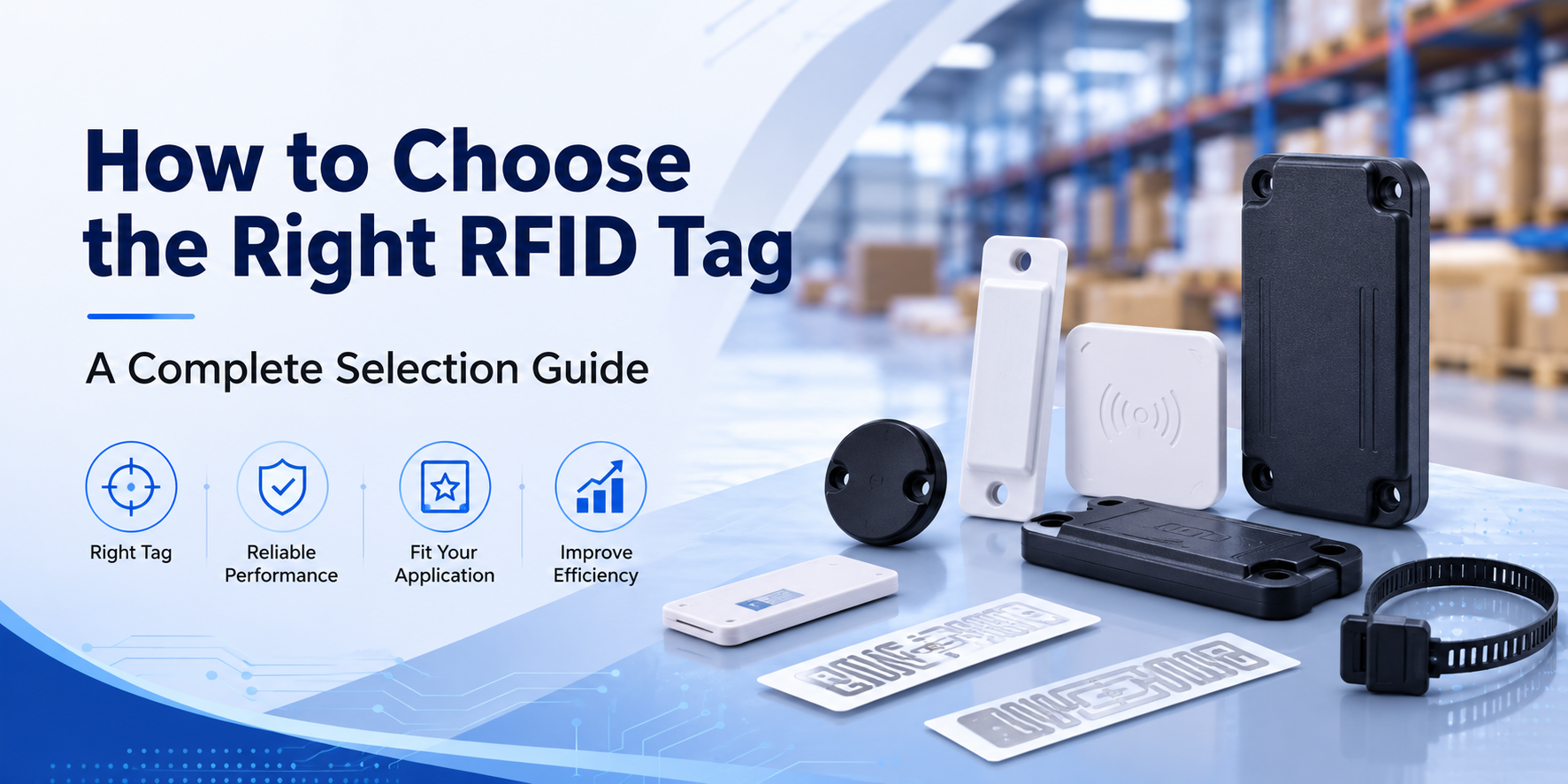
Choosing the right RFID tag is an important step in building a reliable RFID identification and tracking system. Although RFID tags may look similar from the outside, their performance can vary significantly depending on frequency, chip, antenna design, material, size, reading distance, installation method, and environmental conditions.
A tag that works well on a cardboard box may perform poorly when attached directly to metal. Similarly, a small RFID tag designed for retail products may not be suitable for industrial equipment exposed to heat, chemicals, moisture, or mechanical impact.
For this reason, RFID tag selection should not be based on price or appearance alone. The right tag should be selected according to the asset, operating environment, reader system, required read range, and application requirements.
This guide explains the key factors to consider when choosing RFID tags and provides a practical framework for selecting the right solution for different applications.
The first step is to clearly define what you want to identify and track.
Different applications require different RFID tag designs. Common RFID applications include inventory management, warehouse automation, industrial asset tracking, tool tracking, pallet identification, production line management, retail inventory, laundry tracking, vehicle identification, and logistics management.
For example, a warehouse may need long-range UHF RFID tags for pallet and carton tracking, while a consumer product may require a small and discreet RFID tag.
Before selecting a tag, answer the following questions:
These questions provide the foundation for the rest of the selection process.
RFID systems generally operate across different frequency ranges, with LF, HF/NFC, and UHF being the most common categories.
Low-frequency RFID typically operates around 125–134 kHz. It provides relatively short read ranges and is often used for applications such as animal identification, access control, and specialized industrial identification.
LF RFID can perform well in certain environments where short-range identification is sufficient.
High-frequency RFID operates at 13.56 MHz. NFC is also based on the 13.56 MHz frequency and is widely used in smartphones, access cards, payment systems, and consumer applications.
HF/NFC RFID is suitable when close-range interaction is required. It is commonly used for product authentication, smart labels, access control, library management, ticketing, and consumer engagement.
UHF RFID typically operates in the 860–960 MHz range, depending on regional regulations. UHF RFID is widely used for supply chain, logistics, warehouse, manufacturing, and asset tracking applications because it can provide longer read ranges and support fast identification of multiple tags.
If your application involves pallets, cartons, industrial assets, warehouse inventory, or production-line tracking, UHF RFID is often a strong option.
The material surrounding an RFID tag can significantly affect RFID performance.
RFID tags attached to cardboard, paper, wood, plastic, or other non-metallic surfaces are generally easier to design and install.
Metal presents a different challenge. When a conventional RFID tag is placed directly on a metal surface, the metal can interfere with the tag antenna and significantly reduce read performance.
For metal assets, it is usually better to use an Anti-Metal RFID Tag specifically designed for metal surfaces.
Anti-metal RFID tags use specialized antenna structures and materials that allow the tag to maintain stable performance when mounted on metal.
Typical applications include:
When selecting an RFID tag, always test the tag on the actual target material rather than relying only on laboratory specifications.
Read range is one of the most important RFID specifications.
However, a longer read range is not always better. The required range depends on the application.
For example, a handheld inventory application may only require a few meters of reading distance, while a warehouse portal may require tags to be identified automatically as pallets pass through a doorway.
Read range can be affected by:
Therefore, do not select a tag simply because its datasheet states a particular maximum read distance. Real-world performance should be evaluated using the actual RFID reader, antenna, tagged object, and installation environment.
The RFID chip determines important characteristics such as memory capacity, security functions, supported protocols, and compatibility.
For UHF RFID applications, widely used chip families include chips from manufacturers such as Impinj, NXP, and Alien Technology.
When choosing a chip, consider whether you need:
For simple identification, basic EPC functionality may be sufficient.
For more advanced applications, additional memory and security functions may be useful.
The chip should therefore be selected according to the data structure and system requirements rather than simply choosing the newest or most expensive option.
RFID tag size has a direct relationship with antenna performance.
Larger tags can generally provide more antenna area and may achieve longer read ranges, while smaller tags are useful when installation space is limited.
However, the smallest possible RFID tag is not necessarily the best choice.
A tag that is too small for the required read range may result in poor performance. Conversely, an oversized tag may be inconvenient or impossible to install.
Antenna design is also important. Two RFID tags with the same chip can perform very differently because of differences in antenna geometry, impedance matching, substrate material, and manufacturing quality.
For this reason, RFID tag selection should consider both chip and antenna design.
Industrial RFID tags often need to survive harsh environments.
If a tag will be used outdoors or in industrial facilities, consider exposure to:
For harsh environments, durable materials such as ABS, PC, PET, ceramic, or other engineered materials may be more appropriate than paper-based labels.
The required IP rating should also be considered when waterproof or dust-resistant performance is necessary.
For example, an RFID tag used on outdoor equipment may require significantly higher environmental resistance than a disposable RFID label used inside a warehouse.
How an RFID tag is installed can have a major impact on its performance.
Common installation methods include:
For temporary asset tracking, adhesive RFID tags may be sufficient.
For long-term industrial asset management, mechanical fastening may provide better durability.
The installation method should also match the surface. A tag designed for adhesive mounting may not be suitable for rough, oily, dusty, or curved surfaces without additional testing.
The expected service life of the RFID tag should match the service life of the asset.
For disposable logistics applications, a low-cost RFID label may be the most economical solution.
For reusable pallets, industrial tools, machinery, or returnable transport items, a durable RFID tag may provide better long-term value.
A durable RFID tag may cost more initially but reduce replacement frequency and maintenance costs over its lifetime.
Therefore, total cost of ownership should be considered rather than simply comparing the purchase price of individual tags.
One of the most important rules of RFID tag selection is: test before mass deployment.
RFID performance depends on the interaction between the tag, reader, antenna, object, environment, and software system.
A tag that performs well in an open laboratory environment may behave differently when attached to a metal machine, placed inside a plastic container, covered by liquids, or surrounded by multiple RFID tags.
A practical evaluation should test:
Pilot testing can help identify potential problems before large-scale deployment.
RFID tag selection is not only about choosing a product from a catalog. In many industrial applications, the best solution requires customization.
An experienced RFID manufacturer can help optimize:
For challenging applications such as metal asset tracking, high-temperature environments, outdoor equipment, or long-range identification, customized RFID tags can often provide better results than standard products.
Choosing the right RFID tag requires more than comparing read range and price. The correct solution depends on the RFID frequency, target material, required read distance, chip, antenna, tag size, environmental conditions, installation method, durability, and system compatibility.
For non-metallic assets, standard UHF RFID tags can provide an efficient solution for many logistics and inventory applications. For metal assets, Anti-Metal RFID Tags are often more appropriate. For harsh industrial environments, durable RFID tags with suitable materials and protection levels should be considered.
Most importantly, RFID tags should be tested under real operating conditions before full deployment.
By evaluating the application systematically and working with an experienced RFID manufacturer, businesses can select RFID tags that provide reliable identification, longer service life, and better overall system performance.

Thông tin chi tiết và file PDF

Liên hệ hỗ trợ qua email.

Tư vấn kỹ thuật chuyên nghiệp.

Liên hệ hỗ trợ qua email.



LIÊN KẾT

YouTube

để lại lời nhắn
Quét mã để gửi đến WeChat/WhatsApp :



 IPv6 ĐƯỢC HỖ TRỢ MẠNG